– Speedway – Long Track – Ice Racing
FIM World Championship titles, the ultimate accolade for any rider in his sport, are well recorded in many journals and on numerous websites. Winners of its Track Racing disciplines, Speedway, Long Track and Ice Racing, are included here for completeness and in recognition of the riders’ achievement, and also to present the data on a single webpage. Before these official championship there were however several other unofficial World Championship competitions in all three disciplines that took place, in the UK and elsewhere, that today create continued discussion and thus warrant inclusion here.
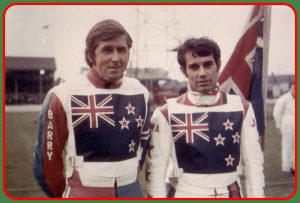
Barry Briggs & Ivan Mauger,New Zealand team-mates in 1970, together holders of 10 Speedway and 3 Long Track Individual World titles.
SPEEDWAY WORLD CHAMPIONS
– THE FIRST SPEEDWAY WORLD CHAMPIONS, ( – pre-1936.)
. Before the first ACU-organised World Championship, held at Wembley’s Empire Stadium in 1936 as “The Auto-Cycle Union Official Speedway Championship of the World” , (it was 1954 before the Wembley Finals came under FIM stewardship though its forerunner, the FICM approved and recognised the ACU’s World title,) there were a number of other championship meetings where the title of World Champion, – Speedway, or its precursor, ‘Dirt-Track’ – , was raced for; see table below.
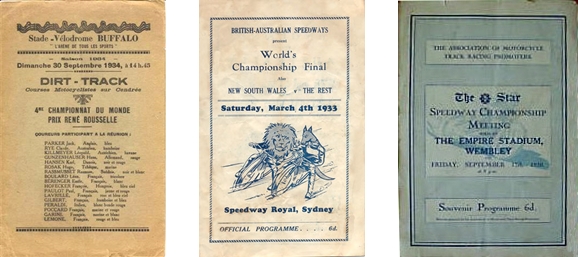
Paris 1934 Sydney 1933 Wembley 1930
With riders migrating South from Europe’s winter not only to Australia but also for a few years to a new venture in Argentina and Uruguay, a “World’s Championship Series” for the “Pour la Noblesse” trophy sponsored by the National Tobacco Company was set up in Buenos Aires by AJ Hunting for the 1930/’31 season. Visitors and local riders met each other 3 times in a series of eliminating match races through the course of the season at Huracan Speedway, Buenos Aires, concluding in February 1931, when American Sprouts Elder made it through to those final stages and, following recent research, is today accepted as having been the winner and thus the first ever World Champion. (An article reviewing the contest can be read here .)
In France at the Buffalo Velodrome, Paris a single meeting for the ‘Championnat du Monde’ was held in October 1931 and was won by the Australian Billy Lamont, ( shown below, with trophy, inscribed ‘Championnat du Monde de Dirt track, 1931 Coupe Brampton’.) The competition became an annual autumn event until the first ACU/FICM Wembley World Final, each Paris staging being dominated by top-name Dirt Track stars at the forefront of the British racing scene and Englishman Claude Rye was a double winner.
In Australia a “World’s Championship Final” was held in March 1933 at Sydney’s Speedway Royal, the programme of which informs of it having had 5 qualifying rounds in Paris, Perth, Adelaide, Melbourne and Sydney, (though it is suspected that the link to Paris was ‘creative publicity’.) Billy Lamont and Bluey Wilkinson, who featured regularly amongst the French prize winners, were pipped for the title by the Englishman from Middlesbrough, Wembley’s Harry Whitfield, (seen below, receiving the trophy: Johnnie Hoskins on left.)
When the first meeting of the 1934 event in Sydney was rained off the Series was re-structured and ‘World’s Derby’ competitions, – World Championships in all but name – , were re-instated, with official ACU status. (The 1939 programme is shown, Rt., winner Jack Milne, his second consecutive win.) Details of the WC qualifier meetings and of the Derby series are to be seen in the extended table below., with background and full rider line-ups given here.
1931 Paris World Championship Trophy presented to Billy Lamont
1933 Sydney World Championship Trophy presentation to Harry Whitfield
In the UK two competitions existed which, at the time or since, have been termed or considered as World Championships. With 2-man match races between star riders often the highlight of any dirt-track race meeting, – the top stars were initially excluded from league race teams – , a match race competition for the ‘Individual World Championship’ was initiated in 1931 by the Promoters Association, the first nominated holder of which was Vic Huxley who beat a nominated challenger, Colin Watson. Huxley was then challenged by Jack Parker who beat the first champion to relieve him of the trophy and be declared Individual World Champion. However, after the event the Speedway Control Board refused to recognise the title: the competition subsequently became the ‘British Individual Championship’, the pre-war forerunner of the British Match Race Championship. Notwithstanding, Parker always maintained his World Champion status, for he had an inscribed trophy as proof !
The ‘Star’ Championship, held each year at Wembley other than in its inaugural year, was launched to identify the supreme speedway rider and is considered by many as the forerunner of the official World Final. As the format of the Star Championship developed, from knock-out match races through to ultimately a 16-rider 20-heat competition, it was supplanted in 1936 by the ACU Final, having exactly the same format, venue, calendar date, and similarly having qualifying rounds at each 1st Division track. Though each year saw a different champion it was 4 years before an Englishman was to see off the Aussie and American stars, who were segregated in the initial year of 1929, being considered too experienced for the English new-starts.
Full results of all ‘Stars’ and other early World Championships are given in the above table.
Below, World Champs’ photos.
~ ~ ~ ~ ~ ~ ~ ~ ~
– OFFICIAL SPEEDWAY WORLD CHAMPIONS, ( – 1936 onward.)
Ove Fundin, 5x World Champ
The above table of official Speedway World Championship winners and rostrum-placed riders is supplemented with the winners of the ‘British Championship’ of 1946 to ’48, so designated because of post-war restrictions on fuel and travel, etc.
Whilst the dominance of New Zealand riders from the mid-fifties to the late ‘seventies can be seen, – nationalities are colour-coded for easy analysis – , securing 12 official championships, in effect this was achieved by just 3 men, Moore, Briggs and Mauger. No other New Zealander has stood on the rostrum then or since. The ‘eighties saw Denmark’s riders to the fore, taking 7 world championships in 8 years and continued rostrum appearances through to date. Their total of 14 championships, the same as Sweden, puts these 2 Scandinavian countries at the top of a national ranking.
Individually, Ivan Mauger and Tony Rickardsson of Sweden (left,) have taken the title on a record six occasions each whilst Ove Fundin (above,) and Jason Crump have each achieved rostrum placings for 10 consecutive years. Club-wise Belle Vue has seen one of its riders of the day crowned World Champ on a record 10 occasions, followed by Cradley Heath with 7 world titles.
World Champions post-1994 have been decided not by a one-off Final but a series of meetings in Grand Prix style. There had been an earlier attempt in the late ’70s to run such a series, the “Master of Speedway”, initially at tracks in Germany, Denmark and Sweden, (see “Masters of Speedway” on ‘Key,Bar,Hammer’ page,) but the project floundered as British promoters discouraged the participation by its British League stars at the expense of UK race-nights.
1936 – ’38 1949 – ’57 1958 – ’77 1979 – ’94 ~ ~ ~ ~ ~ ~ ~ ~ ~ ~ ~ ~ ~ ~
3 World Champs, 15 World Championships, –
Christchurch’s three sons.- Barry Briggs, Ronnie Moore, Ivan Mauger – , in 2013.
LONG TRACK WORLD CHAMPIONS
The Long Track World Championship started life as the FIM European Championship in 1957, (preceded by 2 unofficial ‘dry runs’,) before being re-designated with its ‘World’ title in 1971. The sport has thrived in Germany, and understandably been dominated by German riders, who have been the most successful throughout the decades. (On the continent this title may still be found termed as the ‘Sandbahn’ Championship as the racing surface may be grass, dirt or sand.)
British Grass-Track racers have participated with some success, but it was the Sunday afternoon forays first of Mauger followed by Olsen, etc. that led to UK-based speedway riders joining in the central-Europe based competition, as top flight riders awakened to the lucrative benefits available on the continent. Until the turn of the present decade, in 23 of the preceding 25 years the Long Track World Champion had been British or German, with former England speedway captains Simon Wigg and Kelvin Tatum (above,) taking 7 titles in total, and Swabian Gerd Riss, (below, left,) dominating the era with 8 wins, his last 3 ‘on-the-trot’, emulating the feats of his countrymen Hofmeister and Poschenreider 50 years earlier and making a total of 29 titles for Germany since inception, thanks latterly to Riss junior. The UK follows with 10 titles. (Since 1997 these titles have been decided by a Grand Prix series, following speedways format. Individual GP winners can be seen here.)
A serious injury to Riss in a 2010 GP led to his retirement mid-season, and by 2013 Fin Jonas Kylmakorpi had surpassed the 3 German legends by scoring a 4th consecutive World Long Track Championship title. But the Riss name appeared once more when son Erik Riss claimed the title in his first international LT.GP season in 2014, then, while an Edinburgh Monarch, repeated the success in 2016.
Gerd Riss 8x Long Track World Champ Erik Riss Long Track World Champ 2014, 2016
Long Track World Finals: Marianske Lazne CZ 1976 Eenrum NL 2010
Muhldorf, W.Gy. 1958 Korskro,DK. 1982 Forus, NY. 2011 Marmande FR. 2012
(when EM)
World Long Track final, Herxheim, Germany, 1996
Gerd Riss,(winner,) Gerhard, Berg, Brhel, Hurry.
ICE RACING WORLD CHAMPIONS
The table below of Ice Racing World Champions is still colour-coded by nationality as per the others tables above. It uses white for the predominant successful country, USSR/Russia, – a 75% ‘white-out’ ! – , such has been the dominance of this one nation over the competition. It has had the rostrum 1-2-3 on 24 occasions.
As with the Long Track World Championship and Speedway U21 titles, the competition started life with ‘European’ and ‘FIM Cup’ designations, World Championship status being granted in 1966. (USSR had initiated international exchanges with Scandinavia in the 2 preceding years.) Forerunner champions were Bjorn Knutsson, Boris Samorodov and Gab Kadirov, the latter holding the record of 6 official world titles (plus an ‘FIM Cup’) until that was broken in 2011 by Nikolai Krasnikov, (below,) with an 8th successive win.
Above, 1979: Tarabanko (2nd), Bondarenko (1st), Kudrna,CZ (3rd, – an exception !)
Though the championships have included a reasonable representation nationally, including Britons, – Peterborough’s Andy Ross made 5th place in 1970 – , only a few Czech (in the early years,) and Swedish riders have had much exposure on the rostrum. These have included veteran P.O. Serenius, still racing in his domestic league in 2015 at the age of 67, and his countryman Conny Samuelsson, now a much respected FIM official and referee in the sport.